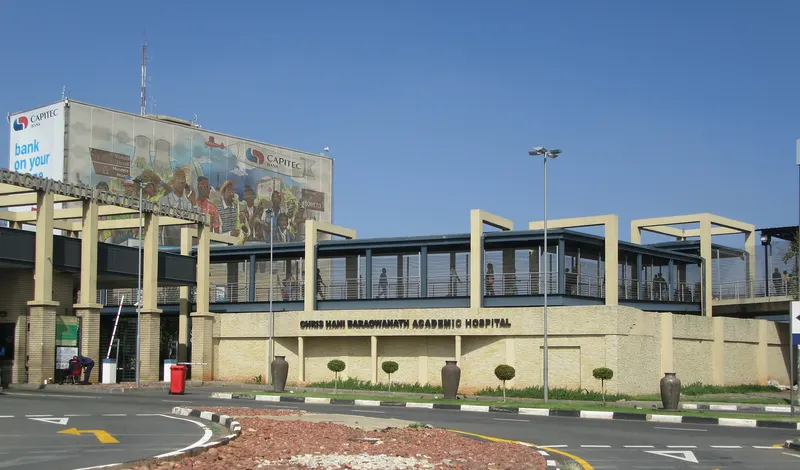
 Photo: amanderson2, Wikimedia Commons, CC BY 2.0
Prescribed Minimum Benefits (PMBs)
What every medical aid must pay
6 chapters in one PDF, every source listed. Free, no sign-up.
Get the free PDFOn this page · 7 sections
What the law says
Regulation 8(1) of the regulations under the Medical Schemes Act: "any benefit option that is offered by a medical scheme must pay in full, without co-payment or the use of deductibles, the diagnosis, treatment and care costs of the prescribed minimum benefit conditions."
Regulation 7 defines a PMB condition as a condition in the Diagnosis and Treatment Pairs (DTPs) of Annexure A or any emergency medical condition. Annexure A also contains the Chronic Disease List (CDL).
PMBs matter in money terms: the CMS reports that schemes spent R135.66 billion on PMBs in 2024, 52.31% of all benefits paid (CMS Annual Report 2025/26).
The three parts of the PMB package
| Part | What it covers | Source |
|---|---|---|
| Emergencies | The sudden, unexpected onset of a condition needing immediate treatment, where no treatment would seriously impair bodily functions or organs, or put life in serious jeopardy | Regulation 7 |
| Diagnosis and Treatment Pairs | About 271 conditions, each paired with a treatment (for example a condition and the operation or medical management it needs) | Annexure A; CMS count |
| Chronic Disease List | 26 chronic conditions: diagnosis, medical management and medicine, as set by treatment algorithms published in the Gazette | Annexure A; CMS count |
The CMS PMB page lists the CDL conditions: Addison's disease, asthma, bipolar mood disorder, bronchiectasis, cardiac failure, cardiomyopathy, chronic obstructive pulmonary disorder, chronic renal disease, coronary artery disease, Crohn's disease, diabetes insipidus, diabetes mellitus types 1 and 2, dysrhythmias, epilepsy, glaucoma, haemophilia, hyperlipidaemia, hypertension, hypothyroidism, multiple sclerosis, Parkinson's disease, rheumatoid arthritis, schizophrenia, systemic lupus erythematosus and ulcerative colitis (diabetes types 1 and 2 count as two, which gives 26).
Some HIV care and menopausal management are part of the DTPs; for these, the CMS says public-sector treatment protocols apply.
Designated service providers and co-payments
Regulation 8(2) lets a scheme's rules say that a PMB is paid in full only if you use its designated service provider (DSP) — a hospital group, pharmacy network or doctors chosen by the scheme — and that a co-payment set in the rules applies if you go elsewhere.
But no co-payment is allowed when you used another provider involuntarily. Regulation 8(3) says this is the case when:
- the service was not available from the DSP, or not without unreasonable delay;
- you needed immediate treatment in circumstances or a place that reasonably prevented you from reaching the DSP (an emergency or accident); or
- there was no DSP within reasonable distance of your home or workplace.
A scheme may also use pre-authorisation, treatment protocols and formularies (Regulation 8(4)). If you knowingly refuse a formulary medicine that is appropriate and choose another, a co-payment may apply (Regulation 8(5)). In an emergency, a scheme may not stop a provider from treating you before authorisation is given (Regulation 8(6)).
How to get a PMB claim paid
- Make sure the diagnosis is coded correctly. The CMS explains that PMBs are identified by ICD-10 codes on the account and prescription; a wrong code can send the claim to your savings account or leave it unpaid once limits are used.
- Ask your doctor to say it is a PMB condition and, for planned treatment, get pre-authorisation from the scheme.
- Register chronic conditions on the scheme's chronic medicine programme so medicine, consultations and tests for a CDL condition are paid as PMBs.
- Use the DSP and formulary if your option has them, unless one of the Regulation 8(3) situations applies — then write down why.
- If a claim is paid from savings or short-paid, dispute it in writing with the scheme, quoting Regulation 8(1) and the ICD-10 code.
- Then complain to the CMS ([email protected]) with the complaint form, proof that you escalated to the scheme, clinical reports and the account statements (CMS complaints procedure).
In 2025/26 the CMS registered 2,455 formal complaints, issued 602 clinical opinions and resolved 1,879 complaints (CMS Annual Report 2025/26). A decision on a complaint can be appealed to the Council within 3 months (section 48 of the Act). See also complaints.
What PMBs do not do
- They do not cover every illness — only the conditions in Annexure A and emergencies. Treatment beyond what the DTP or CDL algorithm describes is paid by your option's normal benefits, if at all.
- They do not oblige the scheme to pay any provider's full fee when you voluntarily ignore the DSP: a co-payment set in the rules may apply.
- New members without recent cover can still face a waiting period: section 29A(1) does not exempt PMBs, while sections 29A(2) and (3) do for people who had cover until less than 90 days before joining (see medical aid).
Already insured?
Next step
Frequently asked questions
What are prescribed minimum benefits?
A minimum set of conditions — emergencies, about 271 diagnosis-treatment pairs and 26 chronic conditions — that every medical scheme option must pay in full under Regulation 8 of the Medical Schemes Act regulations.
How many chronic conditions are PMBs?
26 on the Chronic Disease List, according to the Council for Medical Schemes (diabetes mellitus types 1 and 2 are counted separately).
Can my medical aid charge a co-payment on a PMB?
Only if its rules name a designated service provider and you chose another provider voluntarily, or knowingly refused a suitable formulary medicine. No co-payment applies when you used another provider involuntarily (Regulation 8(3)).
Does a hospital plan cover PMBs?
Yes. Regulation 8 applies to every benefit option a scheme offers, including hospital plan options. See hospital plans.
Are there 26 or 27 chronic conditions on the PMB list?
The Council for Medical Schemes counts 26 Chronic Disease List conditions, with diabetes mellitus types 1 and 2 counted separately. If a document shows another number, compare it condition by condition with the CMS list and Annexure A of the Regulations.
Is pregnancy a prescribed minimum benefit?
Yes, for hospital care: Annexure A lists the pair "pregnancy — antenatal and obstetric care necessitating hospitalisation, including delivery", alongside conditions such as ectopic pregnancy. Antenatal visits out of hospital depend on your option's rules.
Is an emergency always a PMB?
Yes. Regulation 7 makes any emergency medical condition a PMB condition, and Regulation 8(6) says a scheme may not stop a provider from treating you in an emergency before authorisation is given.
Where do I complain if my PMB claim is rejected?
First to your scheme, then to the Council for Medical Schemes at [email protected], with proof of the escalation and your accounts. See Council for Medical Schemes.
Sources
- Council for Medical Schemes — Medical Schemes Act 131 of 1998 and Regulations (consolidated copy, Web Archive)
- Council for Medical Schemes — Prescribed Minimum Benefits (page seen 10 October 2026, Web Archive)
- Council for Medical Schemes — The Complaints Procedure (Web Archive)
- Council for Medical Schemes — Annual Report 2025/26 (copy tabled in Parliament, hosted by PMG)